Another Don’t Jump Article
If you’ve ever asked someone for Street Fighter advice before, you’ve probably heard the phrase “Don’t jump.” It might be the oldest adage coined by the fighting game community.
Jumping feels good and it can lead to big combos, so beginners love to jump whenever they need to make a comeback or find themselves in an uncomfortable situation. Naturally this becomes a lazy bad habit, which is incredibly difficult for intermediate players to unlearn.
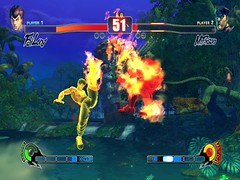
In tactical terms, jumping is a risky gamble because you surrender the ability to block and the ability to control your movement for around 45 frames. Your opponent can predict exactly where you’re going to descend, with plenty of time to react with suitable anti-air – unless they’re in the middle of a 40-frame attack when you jump.
In other words, the direct counter to jumping is doing nothing (or blocking or doing something fast like whiffing a jab) at the same moment as an opponent jumps. Doing nothing is usually very safe and actually counters a wide range of attacks – so experts do nothing often, which means jumping at them is frequently a bad idea.
In fact as players improve, they spend less time attacking continuously and more time looking for things to punish on reaction. Since jumping mainly serves as an easy counter to heavy attacks, it works great at beginner levels and becomes progressively weaker at higher levels.
At least 90% of “advanced” Street Fighter takes place on the ground, so the only way to become an expert player is to improve your ground game. If you spend half the match in the air, then you’re basically avoiding playing real SF. You’re just doing stuff and hoping for the best, because if your opponent does nothing then you take 15% damage, lose all momentum, and have to deal with a wakeup mixup.
Unfortunately when most players take this advice to heart, they decide to never jump and try to deal with everything on the ground. Then they run into a Ryu vs Sagat match and throw fireballs at each other for 80 seconds nonstop.
If your friend knows that you’re refusing to jump, the whole match becomes completely flat and everyone starts overusing unsafe slow attacks on a fake assumption. I thought about this problem for a while and came up with a better training exercise.
Before each round, pick a number between 2 – 4 and that’s how many times you’ll allow yourself to jump forward during that entire round. No matter what happens, you can’t jump forward more often than that number.
This creates a much better simulation of high-level game-planning, because your opponent won’t know whether or not you can jump. It forces you to set up your jumps thoughtfully, so that you’re not overusing them or resorting to jumping for no reason. It helps you focus on preparing your opponent for a jump, so that you’re not wasting your ammo on blind guesses.
You can jump backward and jump straight up all you want, because those are completely different mechanics with totally different roles and risks. Generally they’re much safer than jumping forward, and you’re far less likely to fall into the “I’m gonna jump because I might accidentally land a huge combo and win the match!” trap by jumping backward.
The tricky part is that it’s up to you to determine what “jump forward” means, based on your character choice and play style. For example, jumping forward just because your opponent walked into your favorite jumping distance obviously counts. On the other hand, jumping over Guile’s EX Sonic Boom from full screen distance doesn’t count, because it’s fairly safe and you’re not even trying to hit Guile with an air attack in that scenario.
Attempting a crossup after a knockdown shouldn’t count, because it’s pretty much free. Sometimes instant divekicks don’t count, especially when you’re using them as hopkicks. Randomly busting out Akuma’s demon flip or Guy’s bushin flip definitely counts though.
Using air Hurricane Kick to escape the corner might not count if the opponent is in a position where they can’t do anything about it whatsoever, but it should count if they’re standing half screen away and you’re being lazy. Guy’s ghetto jump elbow gimmicks don’t count from super far away, but they should probably count when you start abusing them from close range, such that even the fakeout ones become punishable. Anyway, you get the idea.
As you learn how to utilize jumps more efficiently and find better ways to attack without jumping, keep in mind that “Do you know why you jumped?” is not a yes-or-no question. Rather, it’s a matter of degrees of certainty. Unless you’re a telepath, you can never have a clear uninterrupted view of your opponent’s mental state. What you have is a moving target, perpetually drifting in and out of focus.

That’s where the nuance of fighting game strategy comes from. You’re constantly building up knowledge of your opponent, then deciding when you’re sure enough of their next action to take a major risk – like jumping forward right when you expect them to throw a fireball.
It’s up to you to decide how aggressive (anticipatory) or conservative (reactionary) you want to be, by regulating how often you take chances in a given match. If you don’t take enough risks, you become predictable. If you always take risks at the same intervals, that also forms a discernable pattern. Be a little random to keep them guessing!
Sometimes you might even know without a shadow of a doubt that your opponent is about to throw a fireball, but decide to let them get away with it since you have a comfortable life lead, just to save that read for a future round when you might need to make a huge comeback.
Whenever you reveal that you know what your opponent is thinking, and they’re alert enough to realize what happened, it disrupts their flow momentarily. If it startles them badly enough, they might even rearrange certain attack patterns or stop using that move entirely.
Every time you reach into the pond to grab a fish, the ripples make it hard to see through the surface. Some players don’t mind waiting until the water calms down between reads. Some players only reach in after they’ve spotted multiple fish that are far enough apart to stay in place. And some players know how to read the ripples.


All of this is just one suggestion to help you focus on the ground game. The topic came up at work during lunch/dinner and led to an interesting discussion, so i turned it into an article.
If it works for you, cool. If you try it and it doesn’t help you at all, then you might have to find another way to keep yourself on the ground. I mean, if you find yourself looking for loopholes to give yourself more excuses to jump, then it kind of defeats the purpose of the whole thing.
Someone asked me how C.Viper would fit into this. She’s kind of an odd case because she’s almost a Marvel character in a Street Fighter game. But i’ve never heard someone say “That Viper player has solid fundamentals” so that’s the price for mastering a janky character.
I guess that means you can get good at SF4 without developing a ground game if you only play certain characters, but you’ll have to go through this process sooner or later if you ever decide to switch to a “traditional” Street Fighter character like Ryu, Guile, Chun Li, Honda, Cody, Zangief, Sagat, etc.
sonic hurricane dot com was the first place I had ever heard the infamous “Don’t jump” adage, and it’s been extremely valuable ever since. So I just want to say thanks for informing me, Maj :D
I don’t take SF too seriously (I mainly play online), but whenever I play against a newer player, I always try my best to emphasize the things that newer players don’t think about via my gameplay, and jumping is definitely one of those things.
During/at the end of a session, my friends definitely recognize that jumping all the time is a bad thing, either because I told them outloud, or they landed on top of Guile’s low fierce a couple dozen times. When they learn not to jump, it suddenly becomes much less of me going through the motions and more of them trying to think about how to win without jumping, and it’s always more satisfying to play against them afterwards.
Also, about Viper players not having good fundamentals…
http://youtu.be/J-BohsZ8nic
Only a Viper player could get the crowd roaring by simply blocking! XD
(I know it’s a different game, but technically MarilinPie is still using Viper, so whatevs :P)
Also, I don’t think I could ever play as SFIV Series C.Viper, even casually. She’s just so…janky, as you say. I’m too much of a zoning guy to even understand what’s going on with her >_>;
Haha thanks. That’s pretty funny, even if it’s a bit of a stretch. Marvel generally makes superjumping okay because you can airblock almost everything and because you get to keep movement control in the air.
In fact with some MvC3 characters, the main reason you wouldn’t want to jump is so you can jump slightly later. Marvel has its own fundamentals though, so there are similarly advanced mindgames taking place during matches; just with different pieces.
Btw i took a few random SF4 screenshots to lighten up the wall of text.
Very happy to see sonichurricane with another strategy article, i think your “pick a number of times to jump” method can be aplied to any lazy pattern a player has, be it jumping, or using low roundhouse, or focusing. So thats really nice.
Yup, it works well for all risky gambles and heavy punish payoff moves. I’m glad you mentioned low roundhouse because connecting a sweep in footsies is the most satisfying part of Street Fighter for me. But you can definitely get yourself in serious trouble with that move, and of course the same is true for psychic DP attempts.
Also those “2 – 4″ numbers are kind of arbitrary, but i picked them because they’re small enough to keep track of easily, without wasting too much concentration on remembering if you jumped five times or six. Anyway eventually you get used to setting up your jumps properly and only jumping when you have a good read. The actual numbers become less important as you get closer to that mindset.
Though if i had to pick a number for psychic DP, i’d probably go with once per match or once per round at the most.
Thanks for this great article. When I started with SF4 alot of people told me jumping is bad so I tried to jump as less as possible and with Ryu I seriously didn’t jump at all (only neutral jump over fireballs). I recently switched to Akuma and I noticed myself jumping more often, but just to bait out an uppercut with the airfireballs or a cr.mk/hk right before you land. But Akuma’s airfireballs are also a great pressure tool.
Well, I have a question about “jumping backwards” and throwing fireballs in SF4. Players like Infiltration and Tokido often jump back and use airfireballs. It seems like they are ABUSING Akuma’s airefireballs. I am just wondering when to exactly zone with airfireballs and when to use ground fireballs? And which should I use more? Daigo’s Akuma used alot more ground fireballs, but I guess this inclination comes from his Ryu.
Akuma has always been the gimmickiest Shoto, which means Akuma players tend to bend the rules with exceptions pretty often. I think you can jump a little more often with Akuma than you could with Ryu or Ken – as long as you’re not overusing scrubby patterns like jump back air fireball then demon flip divekick. Everyone knows that’s just lazy and careless.
Tokido and Infiltration are both very technical players, so they’re always striving to get the most mileage out of Akuma’s unique advantages. Those guys spend a lot of time in Training Mode finding concrete solutions to specific situations, and ways to create those situations with minimal risk. If you want to extract the most out of Akuma’s arsenal, study what they do.
Daigo prefers relying more on fundamentals and figuring out his human opponent face-to-face, so his gameplan always involves more traditional baits like ground fireballs. If you just want to focus on learning fundamentals, Daigo is one of the best players to study.
Whenever you play, it’s really up to you to decide what you want to practice that day. Sometimes it’s cool to try out some new tech you saw on stream. Other times you might want to see if you can predict exactly when your opponent will use an overhead. Both aspects are fun and useful, especially for a game like SF4 which seems like it’ll be around for a while, meaning the time you spend practicing new tech will remain relevant for a while.
I do find the jumping thing peculiar… The problem is, playing online you fight a miriad of people (hell it’s probably the same in reality, just that i enver did it with a competetive crowd)
for example, at my level, sometimes i’ll play someone who anti-airs flawlessly, so i pretty much stop jumping & look for another route of entry, on the flipside i play people who, either through there characters lack of a strong option or otherwise, don’t anti-air. Is it bad to abuse this? I was always under the mindse that your searching for holes in your opponents game. Or are we assuming that if Anti-airing is hard for a player then it’s not really at a level where we/they/i should be taking fighters seriously?
On top of that, wouldn’t character variation come in to play? I mean i’ve seen games with top players who struggle a great deal to effectively plug some of Blankas awkwardly angled jumps, as well as Adons.
I do agree that jumping is a lazy form of entry though, very hit-&-hope… Certainly not a learning tool for progression, one of my favourite things from watching top Gief players is the slow progression entry it can take, or slow pushing to the corner. (Only to lose it in a heartbeat on occasion :P) Makes you wonder how people who use those characters have the dedication to follow a character with such a laborious task every match, but i s’pose getting in & causing havoc is the fruit they play for.
I remember watcing a match VS Daigo in which he won the entire game, near enough, with Crouch MK & fireball. I can’t remember what character he used, strange i’d forget such a big thing.
& this bloke tried all the tricks, fast focus through fireballs. (Got pegged with a MK -> Fireball) jumping (Ate an SRK, everytime) slow entry (MK -> Fireball pushed him back to a managable position) he couldn’t even push him to the corner because Daigo held his ground so solidly.
I watched the match a few times over & came to the conclusion that i couldn’t think of a single thing that Ken could’ve done to get in on him.
Before i watched that i thought zoning was a negligible part of the game.
If someone’s letting you jump at will and you want to help them improve their anti-air skills, then by all means, keep jumping at them. Maybe it’ll pay off in the long run and you’ll gain a solid training partner.
On the other hand if you’re trying to improve your own skills, it’s better to avoid jumping because you can learn much more by staying on the ground. Even if they’re just throwing out random attacks, learning how to navigate through all that garbage on the ground is much more challenging and valuable than just jumping over whatever they do.
I mean, what do you get out of jumping at players who can’t anti-air? If you want to practice super basic jump-in combos, you can always do that by yourself in Training Mode, right? And it’ll be ten times faster and more efficient. I think it’s better to practice ground zoning against other players.
I was just reading a book, Zen in the Martial Arts and it has this chapter called Active Inactivity. This guy was Bruce Lee’s student, and Lee told him
“Many martial artists attack with the force of a storm without observing the effect of their attack on the opponent. When I attack I always try to pause – stop action – and study my opponent and his actions before going into action again. I include pause and silence along with activity, thus allowing myself time to sense my internal processes as well as my opponent’s”
Then I randomly decide to check in here and see -
“Doing nothing is usually very safe and actually counters a wide range of attacks – so experts do nothing often, which means jumping at them is frequently a bad idea.
In fact as players improve, they spend less time attacking continuously and more time looking for things to punish on reaction.”
Maj – I didn’t know you trained with Bruce!
Haha that’s a very flattering compliment. Even having a single conversation with Bruce Lee would’ve been beyond awesome. Although i guess it’s not too surprising that there’d be some similarities between fighting games and martial arts – at least on the metagame level.
The cool thing about fighting games is that they allow a lot of players to reach that level of understanding, whereas only a few martial artists ever get to experience it. You have to be fortunate enough to have some degree of physical athleticism, and then you have to be lucky enough to survive a lot of fights without serious injury. It takes years or even decades, so not many people make it to the cool part.
Both metagame and “physical”. As a fighter/martial artist, knowing the range of your attacks and being able to move in and out of an opponents range are important, as well as knowing which attack is best suited for which range…you wouldn’t try to elbow someone in punching range, but you wouldn’t want to punch someone that you’re right next to either, you would elbow or knee them. SF actually reflects this in the way the animation changes when you’re close to your opponent lol…you have to know to use all your tools. Its extremely similar to having a good ground game and knowing which anti-airs to use at the correct distance. If I’m playing as Ryu, do I use crouching fierce, standing roundhouse or DP in SF4…its very similar…in a way it is real life footsies but with more options..
The metagame is then layered over the above just like in SF4. But, as you rightly pointed out, not many people reach the level that you can do that in real life competently/without fear. You need the athleticism, the speed, the reflexes. the confidence/ability to keep going after taking as hit and the muscle memory in your entire body as opposed to primarily your hands. Also fight readiness and fitness are qualities that leave much faster when you’re not practising as opposed to gaming..that’s why fighting games rock..lol..I could lay off for 3 months and pick up a controller and its like i never quite stopped..as you said, the stakes aren’t as high (no injuries besides those to our egos) so more of us can get to the cool part
Not having to worry about injuries is definitely a big deal. Imagine what it must have been like a few hundred years ago, when people fought with swords and medicine was practically witchcraft. You would have to get lucky to survive your first few fights, right? There’s no other way around that fact.
No matter how much you train by yourself in any fighting game, you’ll probably get eliminated 0-2 in the first tournament you enter. It happens to everyone because it’s such a different atmosphere and suddenly you find yourself in a completely foreign emotional state. Ask anyone, even the best player you know. Chances are, they went 0-2 in their first tournament.
That means all the legendary swordsmen of the world were lucky to escape serious injury in their first few fights. Isn’t that crazy? You have to win maybe 3-4 fights before that experience starts to kick in, right? For every duelist who reaches intermediate status, there are 7-15 opponents who must lose.
Nowadays medicine might heal those people, but back then, those poor bastards would be dead or injured badly enough to never be able to compete again. That’s a damn costly entry fee.
Have you seen the movie Unforgiven? I always liked the way Clint Eastwood’s character explained the key to winning a gunfight. It was simple knowledge, but you got the sense that very few were fortunate enough to reach that level of experience. Even if you were lucky enough to overhear that information, it probably wouldn’t help much – because knowing words and having experience are two completely different things. When your life is on the line, knowing clever words isn’t enough.
It’s interesting to think about.
Yes, I did watch Unforgiven. It was simple knowledge…not so much handspeed but steady hands and in the end when the opponents were panicking and he was just calm and “taking his time” and shooting. Great movie. You’re right though, knowledge without experience isn’t enough and he either learnt that through experience and was quite fortunate to make it that far, or even better, was taught by someone, and kept it in mind during a gun fight..
Something I wanted to ask you…do you think that you can reach a point where your reflexes simply limit your game. For example, I play Ryu but I find that reacting to jump ins from just outside crouching medium kick range is quite difficult. As a result they don’t respect my air control and I get ticked thrown. I can however react better with Guile, its easier to do a flash kick than a dragon punch from a static position because with Guile you’re charging consistently. I guess I wonder if your physical limitations/execution limitation at some point determines the character you play. I remember Lamerboi said that he couldn’t get Ryu’s FADC to Ultra done consistently so he chose Guile and he went pretty far with him. What do you think of this in general?
My two cents is common knowledge I suppose, but while waiting on Maj’s reply I’ll give it as a chun in sf4 who is trying to figure out why sometimes he can anti-air fast enough to air throw a Honda butt slam(and a blanka ball once lol) and sometimes unfailingly hit whiffed Ryu crouching forwards, but at other times get jumped in 5,6,7 times in a row(then seem to spend great effort to finally anti-air once which would of course be followed by going back to failing to challenge the next 5 jump-ins again), and also repeatedly fail to hit Ryu’s slowest-sweep-recovery-in-the-game(?) whiff.
Actually wait: far better than my two cents are a couple of good links if you haven’t read it already: http://shoryuken.com/2012/07/19/lost-strategy-series-quick-guide-to-reaction-based-defense-by-thelo/ (about reactions) and http://shoryuken.com/2012/07/16/lost-strategy-series-the-role-of-execution-by-james-chen/ (about practical consequences of different special move inputs). About reaction speed as a limiting factor, I think there is of course a limit, e.g. perhaps an old man’s nerve endings physically give the information from the eyes to the brains and then to the hands a fraction of a frame slower than a healthy young person?(although I of course have no idea what I’m talking about) But practically I think it’s a lot about concentration and also what we’re expecting(I suspect all those crouching forward whiff punishes were made because I was consciously or unconsciously expecting them, e.g. Perhaps baiting them or expecting him to walk forward a bit and poke so I unconsciously step back a bit while semi-expecting-waiting for a whiff. And about that old man thing it might well be an older brain has less capacity for concentration which would be reflected partially by reaction speed.)
In my own experience(which may or may not be useful to others) I also found it useful to consciously recognize certain specific things to look out for, and also sometimes semi-cheating by developing certain no-brainer rapid reflex reaction, e.g. Boxer’s sweep has a unique animation where his elbow juts out from behind his body before it actually swings out, and if I’m aiming to bait it I try to look for this to give me a more lenient reaction time(the idea being that I can start reacting a few frames earlier than if I were to react to that hand being thrown out). Or sometimes it’s semi-cheating e.g. If I nudge forward against a standing ryu to try to bait crouching forward I can choose to look for and react to a lowering of his body instead of the actual leg(the idea again being that you can start reacting earlier which gives more leeway for reaction time) but it’s “cheating” because I would fall prey to a crouching short fake(or even a simple crouch-and-do-nothing from him lol). Or a reflex action that has served me well is anything that whiffs mere pixels in front of me(almost touching me) I tend to have the unconscious reflex reaction to hit back to whiff punish(this also allowed me to be less vulnerable to fake-out shorts since the short doesn’t reach out far enough to trigger my reflex). For anti-airing it seems to help a little when I tell myself that I’m looking to react even before he starts descending, i.e. sort of like trying to set my start-of-reaction point to earlier in his jump(but against say Rufus this could be useless). This is of course due to chun’s lack of dp so for her the earlier the reaction to the jump-in the more choices of anti-airs she has, but for ryu reacting earlier would make-up for the longer input time as compared to guile flash kick. Basically I’m trying to be aware of how I am unconsciously reacting and see if these are useful reactions and think of specific things that I could use to react to and also their risk factors(e.g. the risk of using a Ryu crouch to react as if it were a crouch forward to whiff punish), training my reactions and identifying which ones can be left as a reflex action(e.g. that reflex action of hitting back upon seeing a whiffed-by-a-pixel attack has so far carried almost no risk for me so I let that reflex action be and even try to develop it, idea being that as a reflex reaction it is extremely rapid and helps me hit whiffed medium attacks); stuff like that.
Hehe what was helpful for me might not be helpful for others but that link is a good read I believe, and reactions can to a certain extent be trained I believe; the more familiar you are with that image(say the image of a whiffed poke or the image of a shoto with hands back cradling that spark that will be the hadoken) the more rapidly you can identify it(almost to the point of not being conscious of it) and I think that reduces reaction time. I also don’t think reaction time can easily be called out in blanket terms; the table tennis player that doesn’t react as blindingly fast at the arcade machine as a pro sf4 player doesn’t necessarily translate to “this person’s reaction speed is slower than the other”. And I think one player who seems to generally have a blanket faster reaction speed than another could also end up really meaning having a better ability to focus, perhaps especially during certain critical opportunistic moments.
Wow, i’m sorry. Somehow i missed that question entirely. But yeah, i agree with a lot of that advice. Even if reaction time gets slower as you get older, i believe your familiarity with a specific game can outpace and offset that.
When it comes to jumping, the first thing you look for is the character coming down at you. That’s hard to react to. Then you gradually become familiar with the differences between a character’s forward jump and neutral jump arcs, so you can tell they’re jumping at you on the way up instead of waiting for the peak. Then eventually you can identify jump startup animations before they even leave the ground, which gives you a much earlier warning sign.
At the same time, you become better at execution so you can input those motions faster. More importantly, you have to learn some tricks to make you harder to hit while you’re trying to execute an anti-air. Don’t overlook the importance of those techniques.
It’s much easier to anti-air with Guile’s Flash Kick than Ryu’s Dragon Punch, but everyone makes the mistake of thinking it’s due to the Flash Kick command being easier than the Dragon Punch input. Once you’ve played Street Fighter for a few months, DP motions are only 10-20% harder than FK inputs, so that can’t be the reason.
Of course the real reason is that Guile inherently stays crouching while anticipating a jump-in. That gives you way more time to react! Especially in SF4, where they increased jump attack hit stun through the roof, you can kick someone in the head and still continue the combo after you land. Jump attacks are performed much earlier in SF4 than they were in oldschool games.
So that means you need to find a way to crouch while you’re preparing an anti-air Dragon Punch. Fortunately, SF4 makes this braindead easy by allowing you to input DF, D, DF+P to perform DP commands, so you never even have to stand up. Have you tried using that method?
Sagat was the character who traditionally struggled with this problem the most, so another trick that oldschool players used was whiffing c.LK or c.LP as soon as they saw someone jump, so they could stay crouching as they performed F, D, DF+P motions. You can also hold DF and delay the punch input slightly, just to get a deeper uppercut without standing up.
The moral of the story is that identifying your weaknesses and finding creative solutions is a huge, huge part of becoming better at fighting games. In my experience, there’s (almost) always something you can learn (in a good fighting game) to overcome any deficiency.
And for slow-in-the-head folks like me who didn’t understand Maj’s reply straightaway,it’s that when you’re crouching the air attack would take a longer time to hit you,therefore giving you "way more time to react". I think. =P
Yup, sorry if that wasn’t clear. Most characters have to crouch in order to perform anti-airs late enough for their invincibility to beat incoming jump attacks cleanly. If you don’t crouch, you’re basically forced to anti-air earlier or you’ll get hit by the incoming attack – especially if your character is tall like Sagat or if the opponent’s jump attack extends downward like Sakura’s j.HK or anyone’s divekick.
Anytime you anti-air early, you run the risk of your invincibility running out before your attack reaches the opponent, which causes you to trade or get stuffed cleanly. So one way or another, you have to learn this stuff.
Thanks guys for the useful tips! Will put them into practice!
I was playing recently, not even thinking about anti airing specifically and my anti air was better than ever, so much so that it completely surprised me. I reflected on it and realized two of the main reasons why it had improved. Now this is just my two cents as xushuren said. May not work for everyone. The first is common knowledge in fighting games in general, the second I’m not so sure.
First reason – opponents are more likely to jump in particular situations that others. Namely when pushed into the corner or after you block a fireball and they try to jump in predicting that you will also do a fireball etc. You need to be able to recognize these situations and take note of them. This is pretty much what Thelo said.
Second reason – I need to be able to recognize these situations automatically or at least register them, but the key word is automatically. In the past while looking to punish jump ins, I would consciously say to myself I’m going to go to this spot, do a jab or a short and draw a jump and punish it. Oftentimes the guy would jump and even though I knew it was coming I still had trouble reacting as well as would I would I have liked. Sometimes I was a split second late and would trade on occasion.
However the last set of matches I played I was watching something on youtube in between matches and I wasn’t even concentrating too intently on the game.
The initial game I had managed to push my opponent (a Gouken who wanted to zone me out) into the corner, by pretty much walking forward and an occasional fireball as opposed to the heavy fireball game that I usually play. He went into the corner, I stood at the end of his jump arc and automatically did my standing jab, standing short feint and the guy jumped and I dragon punched him calmly. Connected cleanly with the two hit medium dp.
Subsequent games my anti air game was still at a higher level than usual.
What was the difference? I thought about it afterwards and realized that on these occasions the dp was completely automatic on my part. It wasn’t so much that I consciously tried to push anyone into the corner and then consciously tried to get him to jump. It was more of, I’ve seen this situation before, and the correct response came out naturally. Subconscious/muscle memory is almost always faster than conscious thought and that’s why I dp’d him so easily…and I then I remembered what made me sway away from playing “automatically” and trying to playing consciously.
I wanted to get better, and decided to play a little bit more consciously during a match because pros “know what they are doing and every move is calculated”. I decided that I was going to “calculate” every move. However I realized that trying to play while “calculating” made things quite difficult for me. I was slower, I wasn’t fluid and while consciously trying to the calculate the pros and cons and risk vs rewards, it was difficult to react to unexpected things.
I’ve now realized that for my game personally I needed to train as many situations as possible offline so that in the real game, my response is automatic, as opposed to trying to actively process everything during the game. Get situations into my “mental muscle memory” so to speak. The best analogy is practicing the FADC to Metsu Hado so you don’t consciously think about it versus thinking “press and hold MK+MP, tap FF let go, do fireball motion twice and press 3P.”
So I needed to trust my experience and if I did get beaten, look back at the footage, see the situation that was giving me trouble and come up with options for it and practice the options offline instead of waiting until the next time the situation came up during a real match to figure it out. Basically the more situations that I saw and could respond to automatically without having to fumble and second guess myself, the more brainpower I could leave free for noticing traits individual to my opponent that I could take advantage of.
I feel that your play on the day (tournament day etc.) is simply the result of all of the work you’ve put in through the training room, watching match videos, playing practice sets etc. coming out onto the stage. Its like at that point it isn’t so much that you are trying to acquire a skill at that point, you’re more letting the skill that you have acquired come out…so when some top players say “I just knew” without being specific about how they knew, I kind of understand. They have seen so many situations and know how to handle each one so automatically that when you ask them, they don’t even remember how they knew what to do, their in game responses just flow naturally
Now this is not to say that I NEVER think in a match, but I found that when I let my “subconscious” deal with most of the regular situations, then I actually picked up on patterns a little more easily. The thing though is trusting yourself…to go into a match and say I trust my experience in these situations and I’m not going to try to force the situation but recognize and adapt to each one as the game flows. It is kind of scary for me to do that, to not to try to reason everything out but trust my experience to make the right decision, to play in the zone…whenever top level athletes are asked about their game they frequently say that they weren’t even thinking, they just executed. I’m no pro but I think that “playing in the zone” is what I’m trying to describe, where you just let your acquired skills come out….that’s my two cents!
All in all it is fairly similar to what xushuren was saying..
Well said. I agree with pretty much all of that. It’s basically the same as reading, right? Where you basically learn to identify entire words and phrases at a glance instead of individual letters. The more sophisticated elements you can spot at a glance, the quicker you can react to complex situations.
Of course that’s also how you get baited into dangerous situations (aka “jumping to conclusions” – an oddly relevant phrase). So you have to keep that in mind as well.
Anyway we all misread similar looking words sometimes, but the answer isn’t to regress to reading letter-by-letter. The answer is to identify easily misread words and be more careful with them, instead of completely losing faith in your instincts every time they steer you wrong.
In fighting games, the earlier you can identify a situation developing, the better your chances of dealing with it. That’s what everyone calls anticipation. If you find yourself cheating too much and guessing wrong, that means you haven’t found an accurate enough way to properly identify the situation.
So you just need to refine your instincts until you can separate similar warning signs. (And obviously it’s harder to do against better players, because they’re better at masking their intentions or straight up lying to you.)
“The answer is to identify easily misread words and be more careful with them, instead of completely losing faith in your instincts every time they steer you wrong.”
That is it exactly…I would play on “automatic” make a mistake, and if I lost the match at a key point, like getting hit by a focus attack on wake up or even a full level 3, I would tell myself, “I had so much time to avoid that focus attack just now…if I had stopped and consciously thought about what I was doing, that would not have happened” So then I lose faith in my instincts and go back to conscious thinking, as opposed to hitting training room and training the situation.
Like training myself to do cr.mk to jab shoryu the way Laugh and Daigo do or even just back dashing if you suspect they are trying to bait out the shoryu.
This has definitely been a learning experience Maj. Getting to bounce ideas off of someone more knowledgeable is priceless. Many thanks!
But was there anything in particular that you disagreed with or have a different view on what I said? I would definitely appreciate hearing your view on it so I could see it from a different point of view
No, i think you’re definitely on the right track. If you’re taking the time to analyze and rehearse specific scenarios, your training is already way ahead of most players. Just keep doing that, keep refining your reflexes, and keep adding more ammo to your arsenal.
Obviously some puzzles are going to be harder to solve than others, but if you keep approaching your gameplan with a critical eye, you can continue improving it boundlessly. There are certain pitalls you have to avoid, but overall you’ve got the right approach.
The only thing i’ll add is that wrong choices are sometimes unavoidable, or at least unpredictable. That’s why there are lifebars in Street Fighter instead of one-hit-kills, that’s why it’s two out of three rounds, and that’s why the tournament standard is two out of three matches. Because sometimes bad luck owns you up.
If you commit to an action (like jumping or throwing a fireball or teching a throw) and your opponent counters, you have to go back and figure out what you did wrong. Unfortunately the lazy answer is always obvious, right? Whatever you did, you should’ve just done the opposite!
Well, that’s a misleading answer to an incomplete question. The real question should be, “Based on the information i had at the time, was a better choice available?”
Sometimes you have to accept that there was no smarter option because you simply couldn’t predict your opponent’s next decision, or you couldn’t limit their options enough. In those cases it’s a complete waste of time to second-guess yourself. Just chalk it up to bad luck and move on.
The next step is to ask yourself how you could’ve obtained additional information ealier in the match, or how you could’ve eliminated more variables. If the answer is that you couldn’t have, then you have to reconsider whether it’s better to avoid that particular situation entirely.
For example, maybe you realize your character simply doesn’t have a way of skewing Zangief’s most basic close-range mixup in your favor. So maybe you conclude that it’s better to never walk toward Zangief at all. (A little drastic, but sometimes it’s worth a try.)
Now if you decide that you’re giving up too much by avoiding that situation entirely, or taking too many risks to do it, or becoming too predictable in the process – sometimes you have to bite the bullet and just guess. I mean, sometimes you just have to roll the dice without letting the outcome affect your mental resolve.
You can’t win ‘em all, so you just need to win more mini-battles than your opponent does, and maintain your confidence in the process.
Got it man. Thanks!